Green Climbers Ultimate Travel Guide

Intro
Green Climbers Home is a climbing camp in Khammouane Province, Laos, located in the middle of one of Southeast Asia's best limestone climbing areas. The camp offers accommodation, food, gear rental, climbing courses, and access to hundreds of sport climbing routes.
Travelling alone? Finding climbing partners is usually very easy. Most guests are climbers, many arrive solo, and the camp's communal atmosphere makes it easy to connect with others and find partners for the next day.
This guide covers everything you need to know before your visit, including visas, transportation, accommodation, climbing information, packing lists, costs, and local tips.
Best Time to Visit
Green Climbers Home is open from October to May. The best climbing conditions are typically found between November and February, when temperatures are cooler, humidity is lower, and dry weather is most reliable.
October
The start of the climbing season. The landscape is still green from the rainy season and at its most beautiful, with lush vegetation covering the valleys and cliffs. Temperatures are around 30 degrees, and visitor numbers are still low, giving the camp a more intimate atmosphere that often feels like one big family.
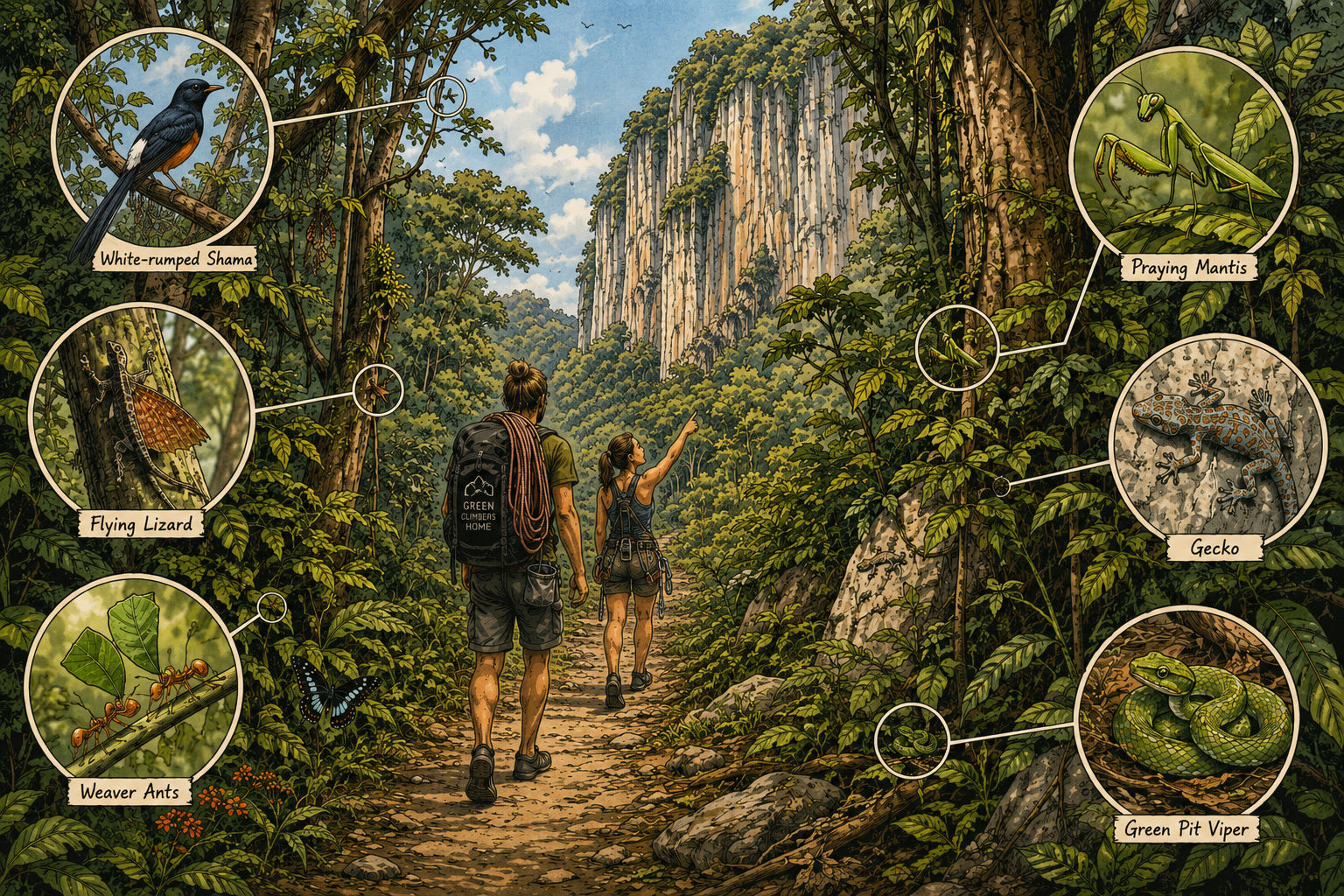
Wildlife is particularly active at this time of year. Encounters with snakes are relatively common, and with a bit of luck you may even spot flying squirrels gliding from the cliffs at dusk. As the dry season progresses, wildlife encounters become less frequent, and snake sightings become quite rare by the end of November.
Occasional rain showers are still possible and some tufas might still dripping.
November - February
Peak climbing season. Cooler temperatures, dry conditions, and excellent friction make this the most popular time to visit. Expect the largest climbing community and a lively, full restaurant. Short rain showers can still occur in early November and occasionally towards the end of February, but the limestone dries quickly and most crags are climbable again almost immediately. Daytime temperatures usually range between 22°C and 28°C, while nights can occasionally drop to around 10°C. Bringing a warm layer for the evenings and early mornings is recommended.
Wildlife becomes less active during this period, and most guests never see a snake during their stay. Thanks to the dry conditions, mosquito bites are rare to - something quite unusual for Southeast Asia.
March
Still a great month for climbing. Temperatures begin to rise, but mornings, evenings, and shaded crags remain comfortable.
Burning Season (March -April)
From the beginning of February until the end of March, parts of Laos and Thailand experience the annual burning season. During this time, farmers burn agricultural fields to prepare for the next planting season, which can lead to reduced air quality and hazy skies.
The Thakhek climbing area is affected as well, but typically to a lesser extent than many parts of northern Thailand. The surrounding landscape is mountainous, with relatively small agricultural areas, while much of the land to the east is covered by dense jungle and protected national parks. As a result, smoke levels are often lower than in regions with extensive agricultural burning, although conditions vary from year to year depending on weather and wind. If you're particularly sensitive to smoke or have respiratory conditions, you may prefer to visit outside the burning season.
April - May
The hottest part of the season. Early starts and climbing in the shade become important. Visitor numbers decrease, making it a good time for those who prefer a quieter atmosphere.
While climbing conditions are no longer at their best, April is home to two of Laos' most unique celebrations: Pi Mai (Lao New Year) and Bun Bang Fai (the Rocket Festival). These festivals bring water fights, music, dancing, rocket launches, and a festive atmosphere that takes over villages and towns across the country. For many visitors, these celebrations alone are a good reason to visit, and some of the most memorable experiences of their trip happen away from the crags. You can find more information in our blog.
Visa and Entry Requirements
Important note: Visa regulations and entry requirements can change. Always check the official Lao immigration website before travelling.
Most nationalities can obtain a Visa on Arrival when entering Laos. The visa fee varies by nationality and is typically between USD 30 and USD 50. Make sure your banknotes are clean and in good condition. Laos is known for rejecting damaged, heavily folded, torn, or marked bills. Travellers have occasionally experienced significant delays at border crossings because their notes were not accepted.
Passport Requirements
Before traveling, make sure your passport:
- Is valid for at least 6 months beyond your date of entry.
- Has at least 2 empty pages available for stamps and visas.
eVisa
If you would like to avoid visa-on-arrival procedures, you can apply for an eVisa before your trip. See our link to the official eVisa application website for details and eligible entry points.
Important for Indian Passport Holders
Indian citizens cannot use the Thai–Lao border crossing at Nakhon Phanom / Thakhek. If you are travelling via Thailand, you will need to enter Laos through a different international border crossing, such as Vientiane.
Getting Here
From Bangkok via Nakhon Phanom (Recommended)
Nakhon Phanom, Thailand, is the closest airport to Green Climbers Home and the easiest way to reach the camp from Bangkok.
Option 1: Fly to Nakhon Phanom
- Fly from Bangkok (Don Mueang Airport) to Nakhon Phanom with Air Asia (flight time approximately 1 hour 40 minutes).
- Take a taxi or shuttle from Nakhon Phanom Airport to the bus station (approximately 20 minutes).
- Take the international bus from Nakhon Phanom to Thakhek (approximately 2 hours, including the border crossing).
- From the bus station in Thakhek, take a tuk tuk to Green Climbers Home (approximately 20 minutes).
Tuk Tuk Price: 350,000 Kip during the day, 450,000 Kip after sunset.
Option 2: Night Bus from Bangkok
- Take the night bus from Mo Chit 2 (Chatuchak Bus Terminal) in Bangkok to Nakhon Phanom (approximately 11 hours).
- Bring warm clothes, as the air conditioning is often set very cold.
- From Nakhon Phanom, take the international bus to Thakhek (approximately 2 hours).
- From the bus station in Thakhek, take a tuk tuk to Green Climbers Home (approximately 20 minutes).
Important
- Don Mueang Airport and Suvarnabhumi Airport are different airports. If arriving internationally, allow around 4h for the transfer between them.
- Bus schedules and border procedures may change, so check current information before travelling.
When arriving at Nakhon Phanom Airport at 4:25 pm?
The last bus to Thakhek departs from Nakhon Phanom at 4:30 pm and is hard to catch, as it takes about 20 minutes to drive from the airport to the Nakhon Phanom bus station.
Therefore, you should take a taxi at the airport directly to the Thai border. After the baggage claim, you will be directed to the taxi / limousine stand where the taxi will be ordered and paid in advance.
Once you are at the border …
- You can board the 4:30 pm bus, which may arrive at the same time as you.
- If there is no bus: hitch-hike over the 800m long ‘Friendship Bridge’ to the border of Laos (it is forbidden to cross the bridge as a pedestrian).
- Pass the Laotian border. You must have your passport (valid for at least 6 months) and US $ 30-42 (depending on your citizenship) + passport photos at hand.
- You can probably get on a bus behind the border.
- If there is no bus: get a tuk tuk called by the officers to bring you to the Green Climbers Home.
Bus Schedule
Nakohon Phanom - Thakhek : 9:00 / 11:30 / 14:00 / 16:30
Thakhek - Nakhon Phanom : 9:30 / 11:30 / 14:30 / 16:30
2nd possibility:
We can arrange a private pick-up service from the airport directly to Green Climbers Home. Price: $80 per trip (1-2 pax) / $100 per trip (3-8 pax)
From Vientiane
- Take a bus from Vientiane to Thakhek (approximately 180,000–260,000 Kip).
- The journey usually takes between 7 and 9 hours. If somebody tells you it only takes 5 hours, don't believe them.
- You can also take a bus to Pakse or Savannakhet and simply tell the driver that you want to get off in Thakhek. These buses pass through Thakhek anyway.
From the bus station in Thakhek, take a tuk tuk to Green Climbers Home (approximately 20 minutes).
Tuk Tuk Price: 350,000 Kip during the day, 450,000 Kip after dark.
From Pakse
- Take a VIP bus (approximately 180,000 Kip) or a local bus (approximately 80,000 Kip) from Pakse to Thakhek.
- The journey takes around 7 hours.
Distances in Laos can be deceptive. Roads are generally good, but buses make frequent stops and average speeds are often much lower than visitors expect. Travel times are therefore often longer than they appear on a map.
From the bus station in Thakhek, take a tuk tuk to Green Climbers Home (approximately 20 minutes).
Tuk Tuk Price: 350,000 Kip during the day, 450,000 Kip after dark.
From Getu, China
- Take a bus from Getu to Anshun.
- Continue by train to Kunming.
- Fly from Kunming to Vientiane with China Eastern Air.
- From Vientiane, continue to Thakhek as described in the From Vientiane section above.
From Yangshuo, China
- Take a bus from Yangshuo to Guangzhou.
- Fly from Guangzhou to Bangkok.
- From Bangkok, continue to Thakhek as described in the From Bangkok section above.
From Kunming
- Take the China–Laos Railway from Kunming to Vientiane.
- From Vientiane, continue to Thakhek by bus as described in the From Vientiane section above.
The train is a comfortable and scenic option, while flying is usually the fastest.
Money
Card payments
- Credit cards are accepted.
- A 6.9% processing fee applies to all card transactions.
Cash payments
You can pay in the following currencies:
- Lao Kip (LAK)
- Thai Baht (THB)
- US Dollars (USD)
- Euros (EUR)
Important notes for cash payments
- For USD and EUR, we can only accept clean, undamaged, and recent-looking notes.
- Lao banks often reject older or damaged foreign bills, so we cannot exchange or use them.
- Please make sure to bring enough cash with you for your stay, especially if you plan to pay on departure.
Make Your Life Easier: QR Code Payments in Southeast Asia
We also accept QR Code Payments with ThaiPromptPay and Lao OnePay
QR code payments are now one of the most widely used payment methods in Southeast Asia, even at small family-run businesses. Recently, several apps have made it possible for travelers to pay by QR code without opening a local bank account. At the time of writing, Moreta Pay is the most popular option and worked flawless with Lao OnePay in the camp.
This is only a personal recommendation based on our own experience. We are not affiliated with Moreta Pay and do not earn anything from mentioning it.
Sim Card and Internet
Internet & Mobile Signal at Camp 1
One thing you'll notice as soon as you arrive at Camp 1 is that there is no mobile phone signal inside the camp. While that might sound unusual at first, it quickly becomes one of the things many guests appreciate most.
Without notifications, endless scrolling, or people disappearing into their phones, the restaurant and common areas have a very different atmosphere. Conversations happen naturally, climbing partners are easy to find, and evenings are spent sharing stories instead of staring at screens. Most guests discover they don't miss the signal nearly as much as they expected.
If you do need to check messages or use the internet, it's easy. A short 200-meter walk from the camp to the yoga studio brings you back into mobile coverage, where you can catch up before returning to the peaceful atmosphere of Camp 1.
Internet, Wi-Fi & SIM Cards at Camp 2
Camp 2 has mobile phone coverage, but we do not provide Wi-Fi. We strongly recommend using Lao Telecom (LTC), which offers the best coverage in the Thakhek climbing area. Other providers may work in some locations, but their signal is generally less reliable around the camp and at the climbing crags. You can buy a physical Lao Telecom SIM card directly at the camp, and we'll help you register and activate it.
If you prefer or can only use an eSIM, make sure to set it up before you travel to Laos. If you arrive without one, the staff at the Lao Telecom shop next to the post office in Thakhek can help you purchase and activate one.
Can I Work Remotely from the Camp?
Yes, but it depends on the type of work you do. The mobile internet at Camp 2 is generally good, but speeds can vary throughout the day. If your work depends on having a consistently fast and stable connection at all times, you may find it frustrating.
However, if your schedule is flexible and you can upload large files later, postpone a meeting by an hour if needed, or work around occasional slowdowns, you should have no problem working remotely from the camp.
Booking Buses and Trains in Southeast Asia: 12GoAsia vs Local Options
12Go Asia is one of the most popular platforms for booking buses, trains, and ferries across Southeast Asia. It can be very convenient, especially when planning trips from abroad, but there are some things travelers should know.
In Thailand, 12GoAsia generally works well and is a useful tool for checking schedules and securing tickets. However, the convenience comes with a price: booking fees and markups can be significant, sometimes making tickets up to twice as expensive as buying them directly.
In Laos, we have heard complaints from travelers about problems with 12GoAsia bookings. Some reported arriving at bus stations only to find that drivers did not recognize or accept their tickets. Others experienced train tickets that had not actually been booked despite receiving confirmation.
For Laos and Vietnam, we recommend booking through your hostel or hotel, a local travel agency, or directly at the bus or train station. It might take a little more effort, but it is usually cheaper and avoids unnecessary problems.
More in depth articles
Volunteering at Green Climbers