Tokay Gecko
Tokay Gecko (Gekko gecko)
Introduction
If you spend a few nights at Green Climbers Home, you will almost certainly hear a Tokay Gecko before you see one. Its loud, distinctive call echoes through the valley after dark and is often mistaken for a bird by first-time visitors. The call sounds something like "to-kay, to-kay," which is exactly how the gecko got its common name. Males use the call to attract mates and advertise their territory to rivals. During the breeding season, the calls can continue throughout much of the night.
The Tokay Gecko (Gekko gecko) is one of the largest and most recognizable geckos in Southeast Asia. It is found from India and Bangladesh through Laos, Thailand, Vietnam, and Indonesia. While its natural habitat includes rainforest trees and limestone cliffs, it has adapted remarkably well to living around people and is commonly found on buildings, walls, and ceilings.
Quick Facts
- Scientific name: Gekko gecko
- Common name: Tokay Gecko
- Family: Gekkonidae
- Length: Up to 20 cm or more
- Activity: Nocturnal
- Habitat: Forests, limestone cliffs, villages, and buildings
- Diet: Insects, spiders, small vertebrates
- Reproduction: Egg-laying
- Venomous: No
Identification
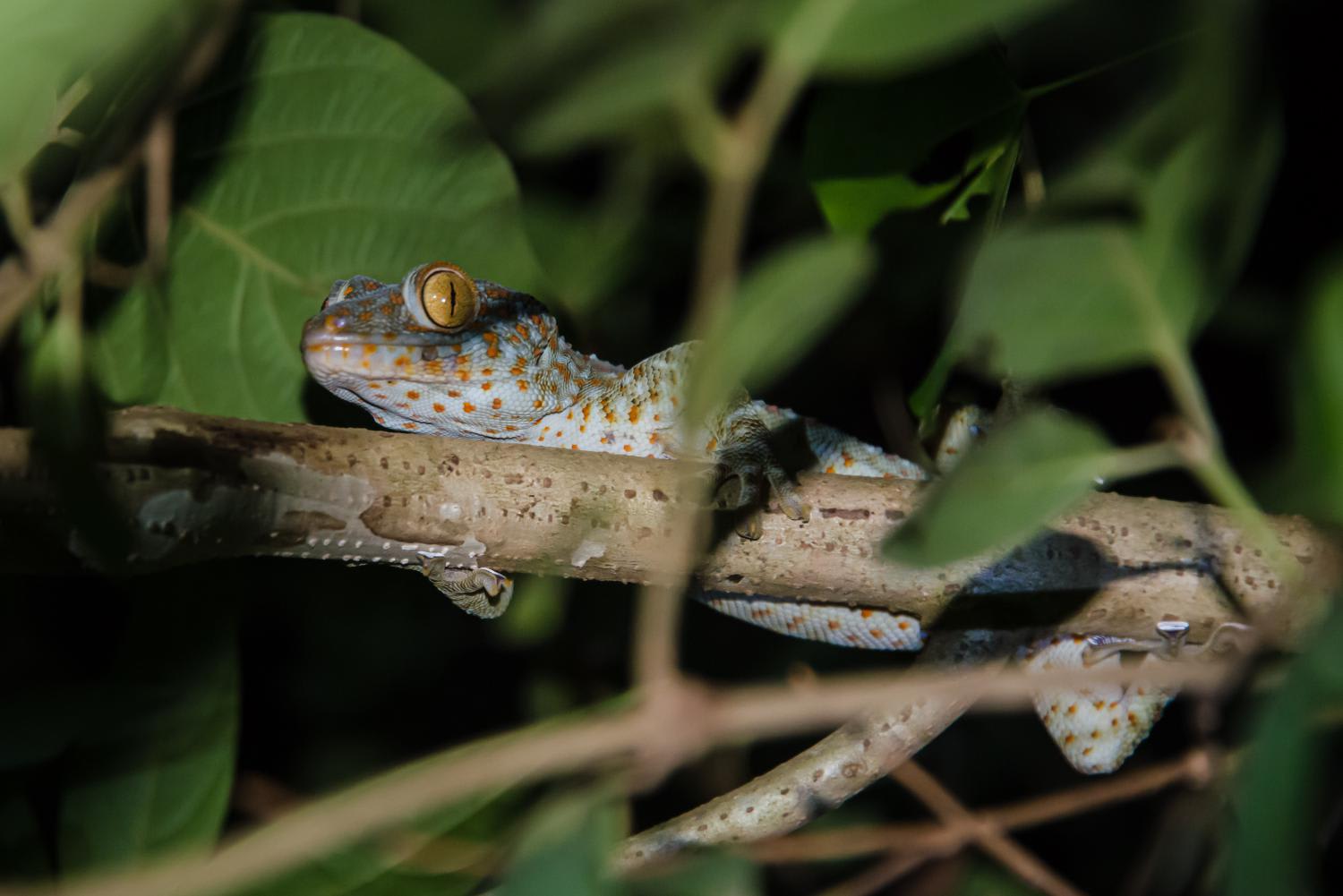
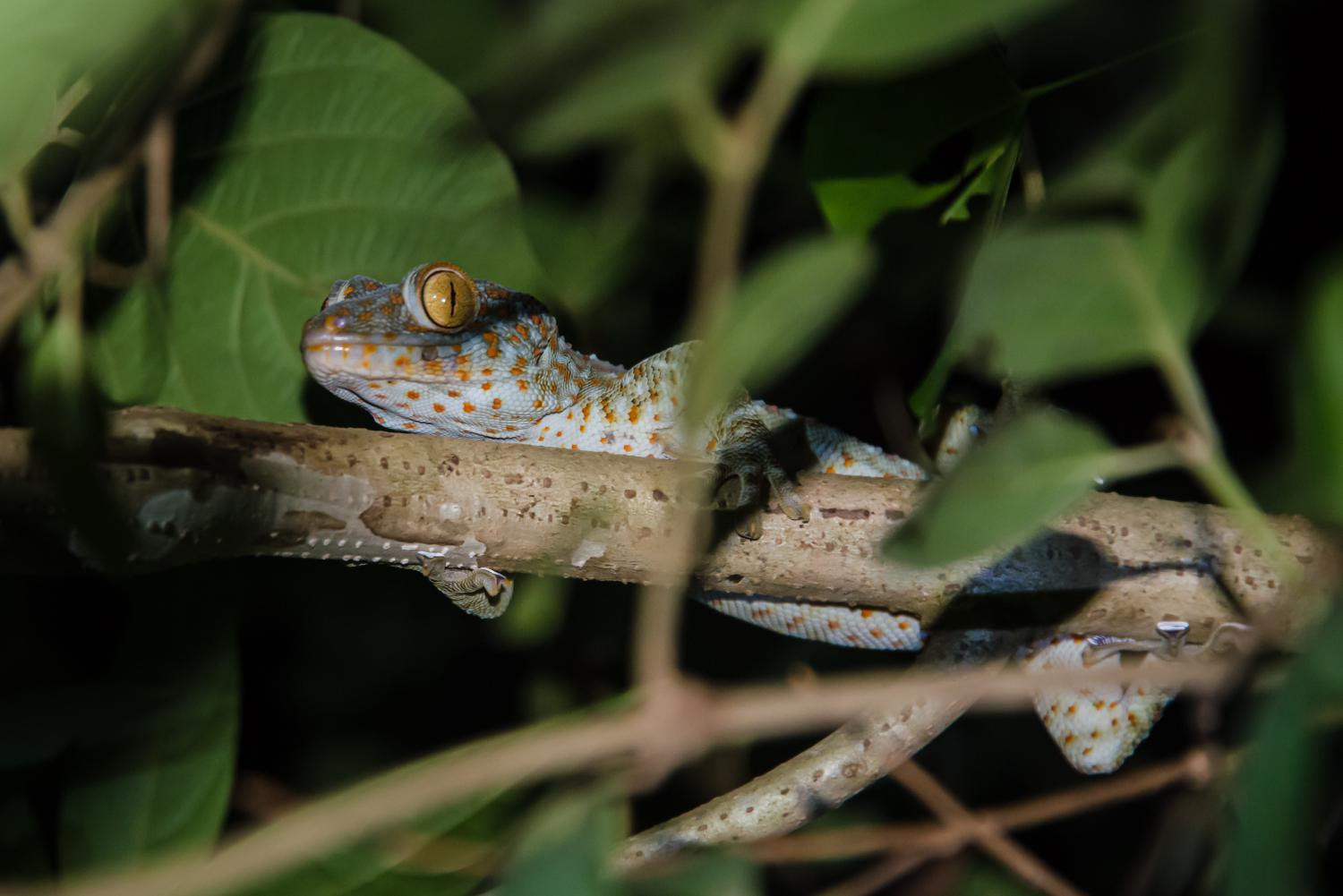
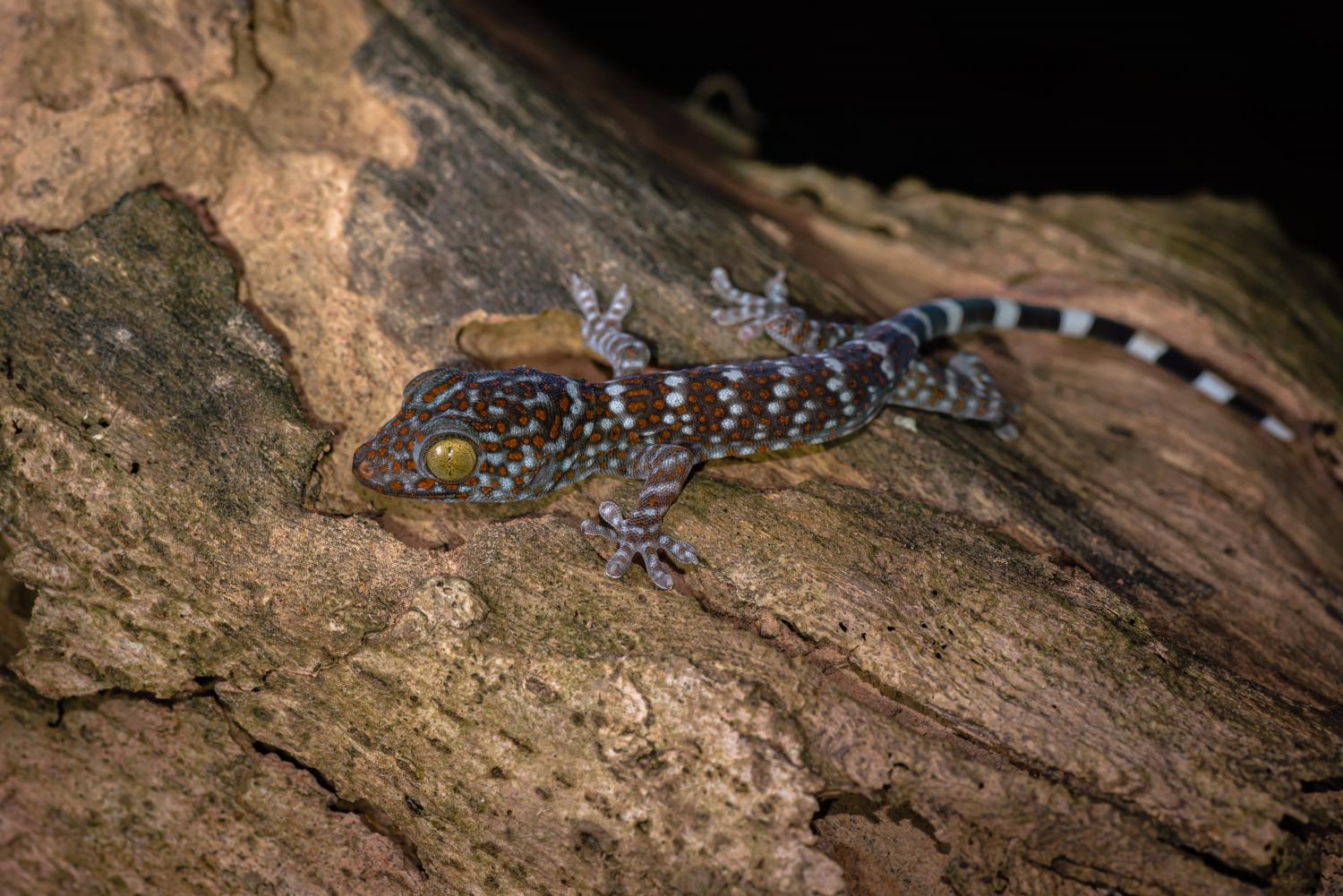
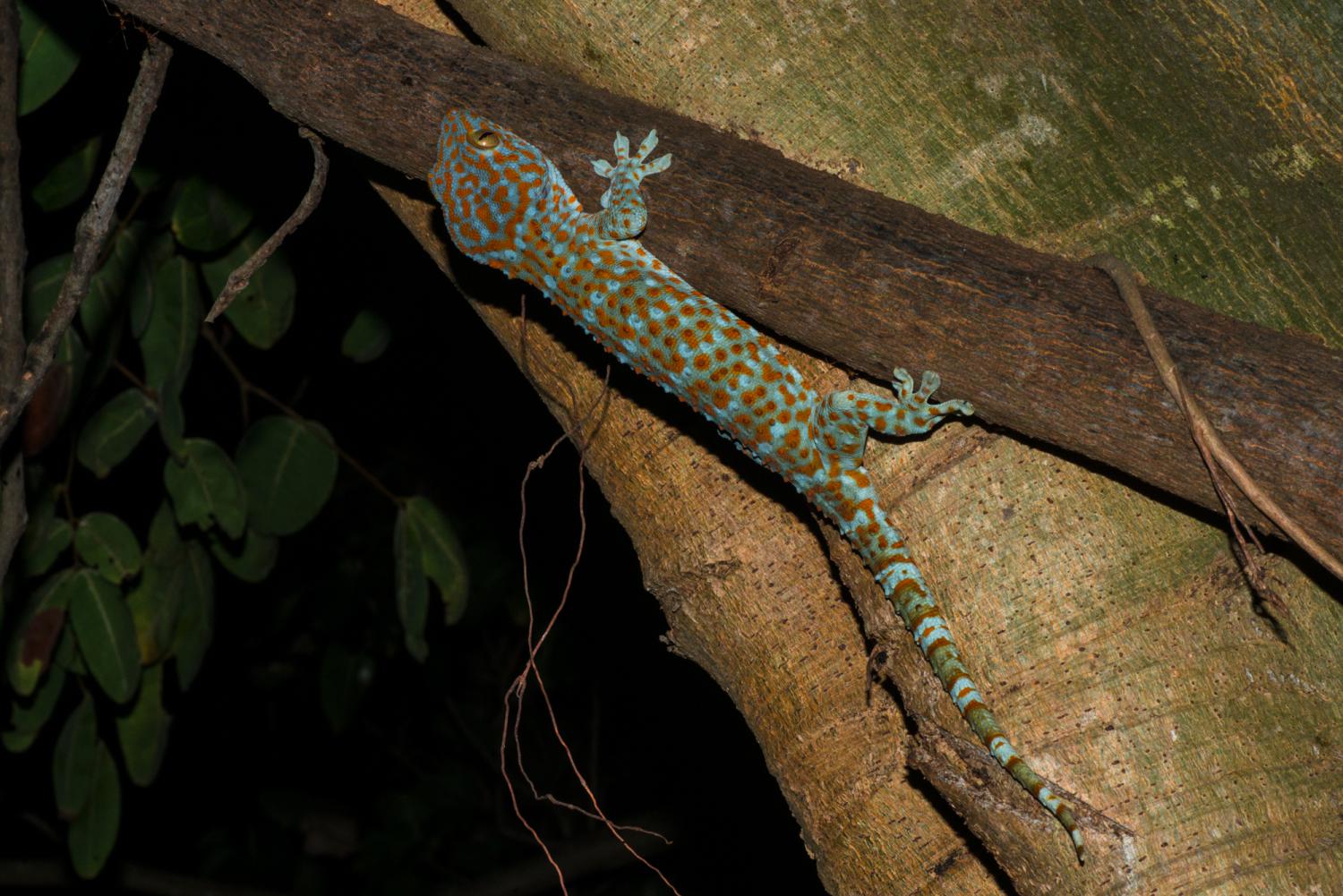
The Tokay Gecko is the second-largest gecko species in the world. Males typically reach lengths of 11–20 cm, while females are slightly smaller. Its body is bluish-grey with bright orange, red, or yellow spots, creating one of the most colorful patterns of any gecko in Southeast Asia.
It has large eyes with vertical pupils, broad toe pads for climbing, a large head, and powerful jaws. Males are generally more brightly colored than females.
Habitat and Behavior
Tokay Geckos are nocturnal and spend the daytime hidden in cracks, tree hollows, roofs, or behind walls. After sunset they emerge to hunt and can often be seen around lights where insects gather.
At the camp they are frequently spotted on buildings, in the restaurant, and around the bungalows. Their ability to climb smooth vertical surfaces and even hang upside down makes them impressive acrobats.
Males are highly territorial and will defend their chosen area against other geckos and intruders.
Diet
Tokay Geckos are important predators that help control insect populations. They feed on a wide variety of prey including crickets, moths, beetles, cockroaches, spiders, and other insects. Larger individuals may also eat small lizards, frogs, and even young rodents.
Their strong jaws allow them to tackle prey that many smaller geckos cannot handle.
Reproduction
Females usually lay one or two hard-shelled eggs in a protected location. Unlike many reptiles, Tokay Geckos guard their eggs until they hatch, helping to protect them from predators.
Human Interaction
Although Tokay Geckos are harmless to people, they have a reputation for having a strong bite. If threatened or handled, they may defend themselves aggressively and can hold on surprisingly firmly. For this reason, they are best admired rather than handled.
Fortunately, they are valuable neighbors around the camp, helping keep insect numbers under control.
Conservation
Tokay Geckos are culturally significant throughout Asia and appear in many local legends and folktales. In some countries they are heavily collected for the traditional medicine trade, despite a lack of scientific evidence supporting the claimed medicinal benefits.
Overharvesting and habitat loss have caused declines in some areas, making wild populations increasingly vulnerable.
The Tokay Gecko is one of the most memorable animals around the camp. Even if you never spot one, you'll almost certainly hear its unmistakable call echoing through the valley after dark.
Source:
Copyright:
Images published under CC License CO-BY-SA
https://www.thainationalparks.com/species/gekko-gecko
https://creativecommons.org/licenses/by/2.0/